An enduring mystery at Pickens Cemetery
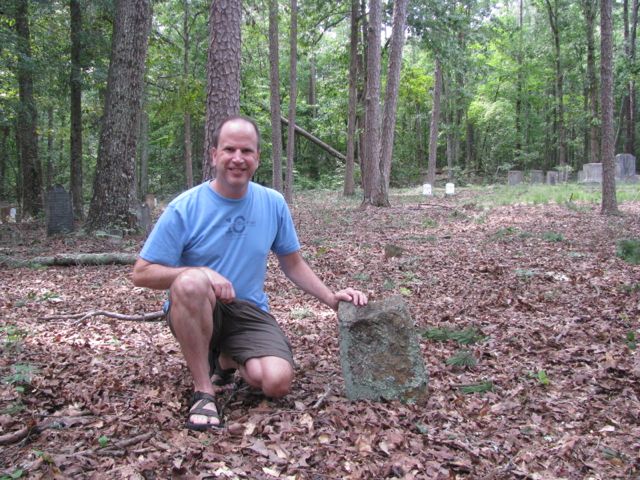
Yours truly with the headstone in question.
For well more than 100 years, local legend in Upstate South Carolina has held that a Revolutionary War soldier named Micajah Hughes is buried in a certain grave at Pickens Cemetery (aka, Pickens Chapel Cemetery), on Three and Twenty Road near Easley, S.C. The grave is marked with a crude flat field stone. When one looks at the stone closely, it appears that the letters “MH” have been roughly chiseled into it.
Some have speculated from there that the “MH” referred to a man named Andrew Hughes, who did indeed fight in the Revolutionary War with a militia unit, who lived within a few miles of the cemetery from 1787 until his death in 1843, and who had a son named Micajah. According to this version of the story, Andrew’s middle name was Micajah, and thus the “MH” refers to him, since Andrew’s son Micajah was not born until 1788, years after the war ended.
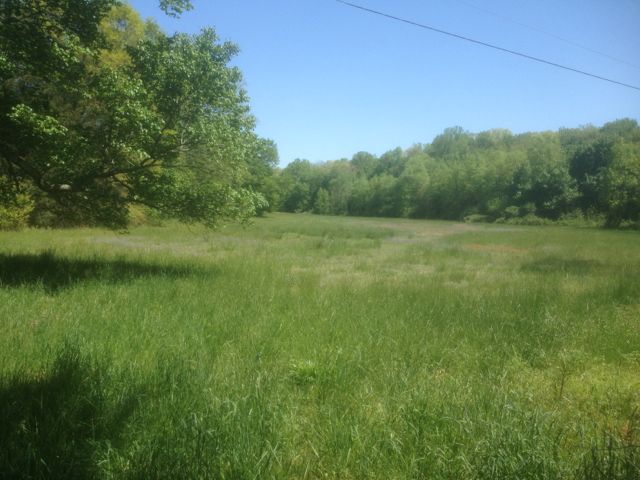
Andrew Hughes once owned land near this location on Mt. Airy Church Rd., 5 miles from Pickens Cemetery.
I have more than a passing interest myself in solving the mystery, since the Andrew Hughes in question was my 4th great grandfather and earliest known Hughes ancestor. I would dearly love to know exactly where he is buried, but I am not convinced that the “MH” grave is his.
Here’s why. First, there is no evidence in official records to support the idea that Andrew had a middle name at all. In all of the official records I have seen for him, including land deeds and the records related to the pensions he received for his service in the Revolutionary War, his name is given simply as Andrew Hughes (although his last name is sometimes spelled as Hues, Huse or Hughs). There is no hint of even a middle initial for him in any of these records.
Second, as I mentioned previously, Andrew had a son named Micajah who also lived in the area near the cemetery for much of his life. However, Micajah lived his final years in northeast Georgia and is believed to be buried in Dawson County, Georgia. So, not only is the “MH” grave unlikely to be Andrew’s, it is also not likely to be the grave of his son.
That’s how I see it. I’m sure there are others who will disagree with me on this.
What in the world happened to Elisha Hughes?
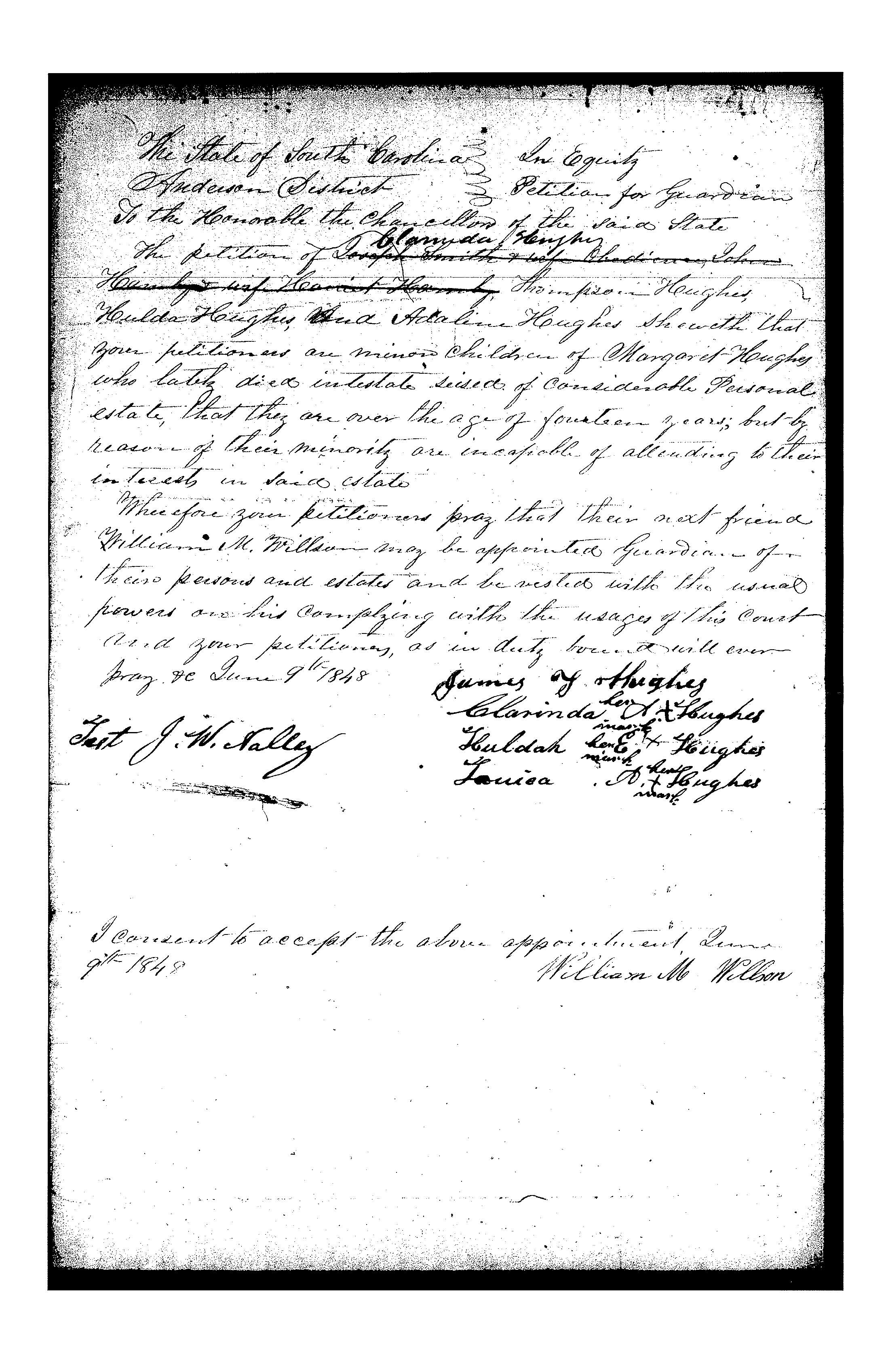
This petition, dated June 9th, 1848, seeks guardianship of the orphans of Elisha and Margaret Hughes for Margaret’s brother, William M. Willson.
Nation, I need your help to solve a mystery that’s more than 174 years old.
By now, readers of this blog (yes, both of you!) know that I am very keen on researching my Hughes family history. (I also plan to write about my mother’s line, the Brelands, but that will come later.)
One of the great unsolved mysteries in my Hughes line is this: What in the world happened to my 3rd great grandather, Elisha Hughes?
The facts of his life, as I currently know them, are fairly sparse. He was born about 1800 (exact date unknown) in the old Pendleton District of South Carolina. His parents were Andrew Hughes (1755-1843) and Obedience Sumner (1765-1829).
Sometimes I have seen his name written as Elisha “Lish” Hughes, and sometimes his middle name is given as “Mattison” or “Madison.” But I have not seen any evidence myself that proves beyond doubt he had any names other than Elisha Hughes.
By 1820, Elisha had married Margaret “Peggy” Willson and his household of two was listed in the 1820 U.S. Census for Pendleton, S.C. But by 1830, Elisha and Peggy were living in Habersham County, Ga. They had eight children together, including my great-great grandfather, James Thompson “Thomps” Hughes (1831-1919).
But by 1839, Elisha had disappeared, and no one seems to know for sure what happened to him. Some have speculated that he may have abandoned his family and traveled west. Others have speculated that he may have died while participating in “Indian removal” from Georgia. The one thing that no one has offered, in what I have read about him so far, is an explanation for his disappearance that’s backed up by evidence.
We know what happened to Peggy — she died sometime before June 1848. We know what happened to the children who were left orphaned when Peggy died — custody of the orphans was awarded to Peggy’s brother in Anderson, S.C. in June 1848, and by 1850 they were living in Pickens County, Ala. We know where both Thomps Hughes and his younger brother, William McMurray Hughes, are buried.
But we still don’t know what happened to Elisha. However, I’m willing to bet that someone out there has evidence in hand that may help me answer that question.
With that in mind, it’s time to put crowdsourcing to work for me. Do you know what happened to “my” Elisha Hughes? If so, I’d love to hear from you. Email me at tahughesnc@gmail.com.
My great-grandfather, James Harvey Hughes (1867-1957)
It seems odd, but I know far less about my great-grandfather, James Harvey “Jim” Hughes (1867-1957), than I know about his father, James Thompson “Thomps” Hughes (1831-1919) or his great-grandfather, Andrew Hughes (1755-1843).
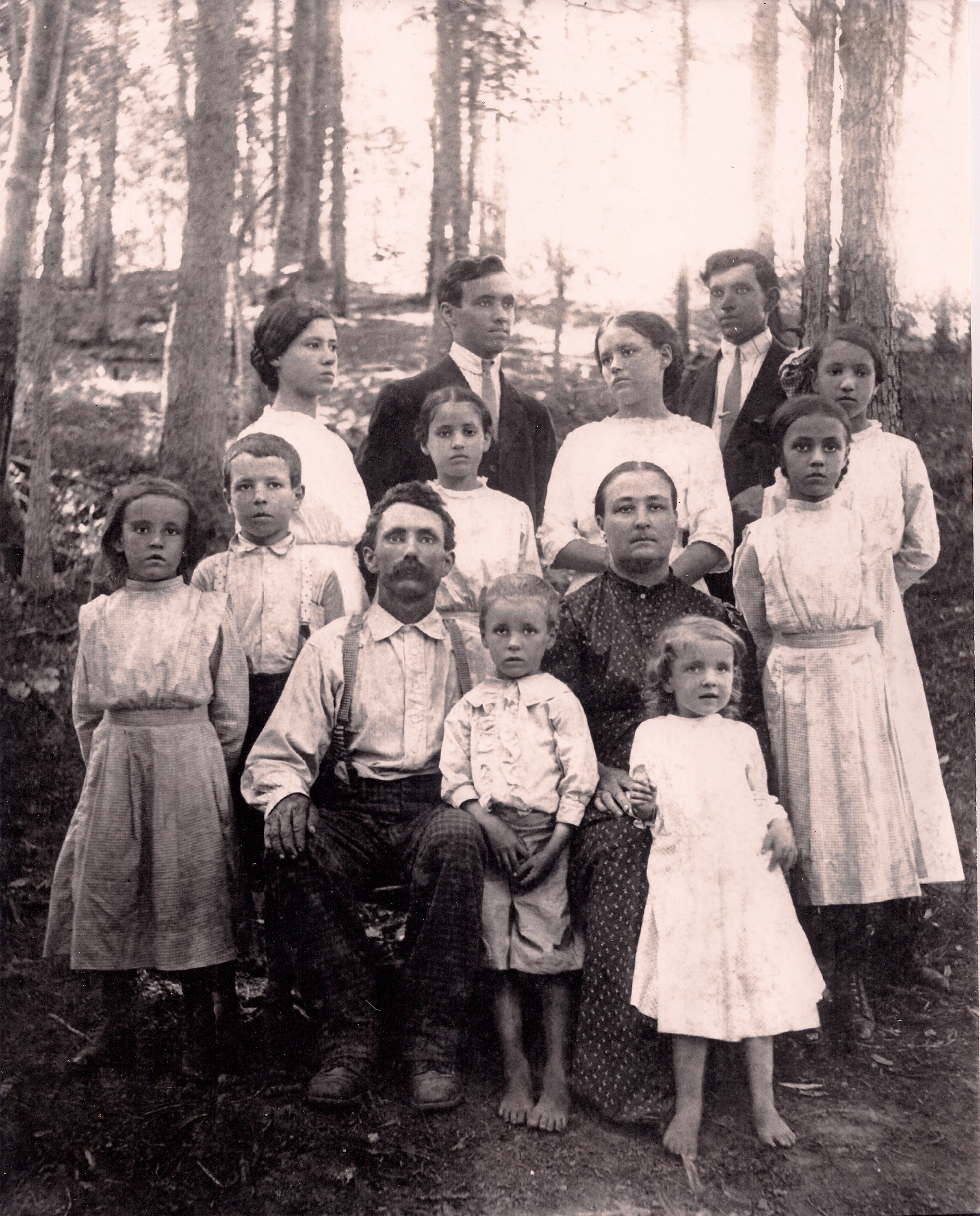
Jim Hughes and family in 1913.
That may be because Jim, as far as I know, never served in the military whereas Thomps served in the Civil War and Andrew served in the Revolutionary War. I learned much of what I know about Thomps and Andrew from records related to their military service.
Here’s what I do know about Jim Hughes. He was born on August 10, 1867, in Pickens County, Ala. He was the first child born to Thomps and his second wife, Jane Mitchell Hughes. Jim married Louisa Thornton in 1889 and they had 12 children. Their first child, born in 1891, was my grandfather, Arley Hughes Sr.
Jim lived the first 50 plus years of his life in the vicinity of Ashcraft Corner, which is in Fayette County but very close to where the boundaries of present-day Fayette, Pickens and Lamar counties meet. But by 1930, when he was 63 years old, he had relocated to Lowndes County, Mississippi, near the town of Columbus. According to family legend, Jim said that he moved to Mississippi “so my daughters wouldn’t have to marry their cousins.” (Two of his aunts, Hulda Hughes Wilson and Adline Hughes Wilson, had both married first cousins of theirs.)
He died on March 20, 1957, at the age of 89. He is buried at Mount Zion Baptist Church Cemetery in Columbus.
The only other information I have about him comes from a one-page bio that was written by my cousin Carol (Hughes) Olive and given to me in the late 1980s. Here is an excerpt from that:
“He was a small man weighing only about 115-120 pounds. To overcome his lack of physical strength he learned to improvise to make his farm work easier. He had a very active imagination and used it to design and build such things as a dry kiln to cure sweet potatoes. He did this before the Department of Agriculture or anyone else that we know of in the state of Alabama did. He was known as a superior farmer that produced not only cotton and corn but also sweet potatoes, vegetables, peaches, apples, strawberries, dew berries, scuppernongs, grapes and any new product that he thought would be profitable.”
Where was the land of Andrew Hughes?
In one of my recent posts, I reported that my 4th great grandfather, Andrew Hughes (1755-1843) settled on 600 acres of land “on the south fork of Brush Creek” in the Ninety-Six District of South Carolina in 1787.
This information is included in a record that I obtained from the S.C. Department of Archives and History. Unfortunately, that record does not provide a description that enables me to figure out exactly where those 600 acres were.
Since then, I have received another document from the South Carolina Archives for 640 acres of land on “Brush Creek” (now known as Brushy Creek) that belonged to a man named Charles Hughes (I’m not sure if he’s related to Andrew, or not). That document, from the year 1791, includes a drawing that shows where this plot of land was. It also includes a notation, written just to the east of the Charles Hughes tract, that says “Andw. Hughes Land.”
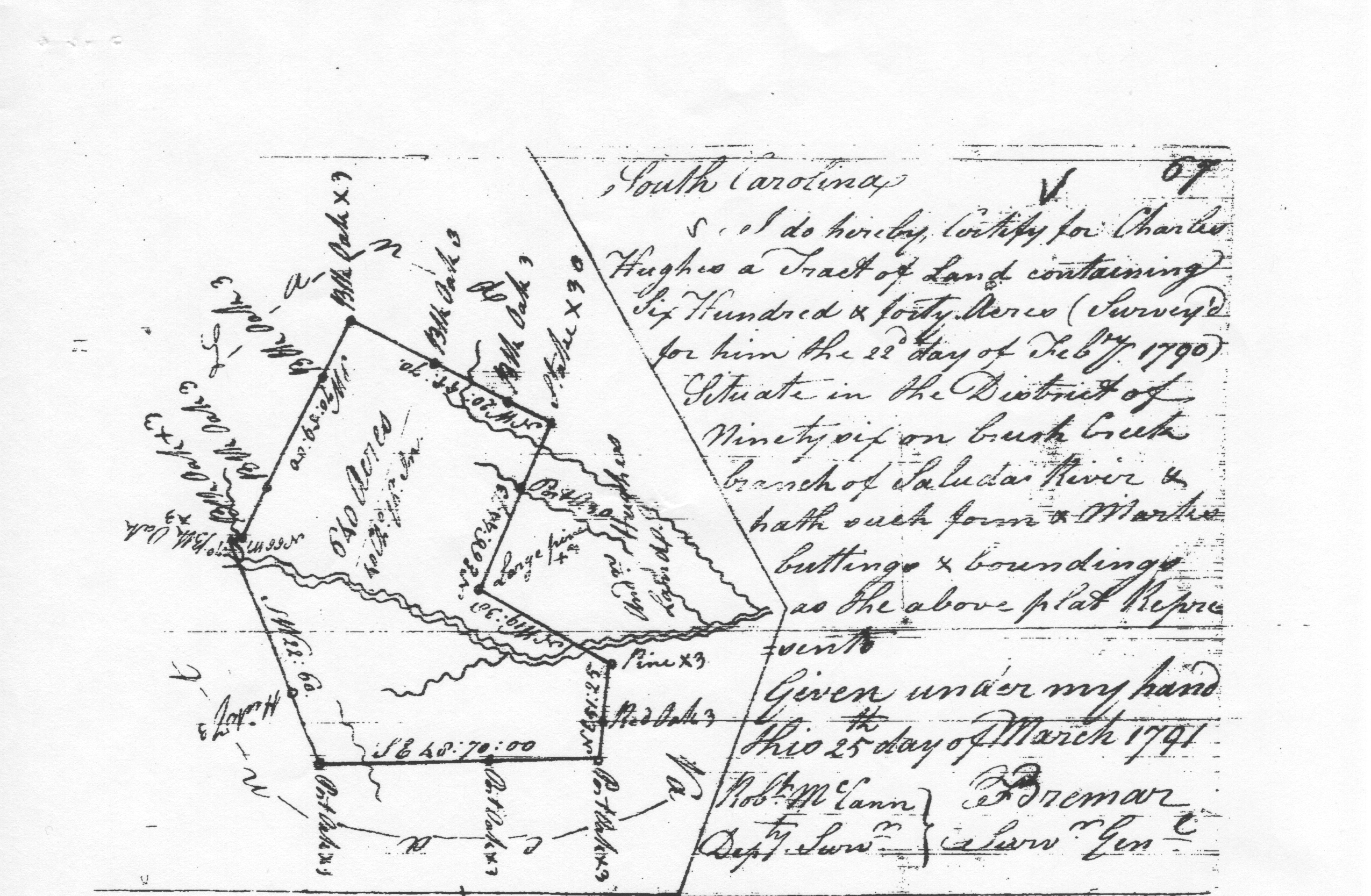
Using the information reported in this document, my brother, Brian Hughes, created this image that shows where he thinks the land of Charles Hughes might have been:
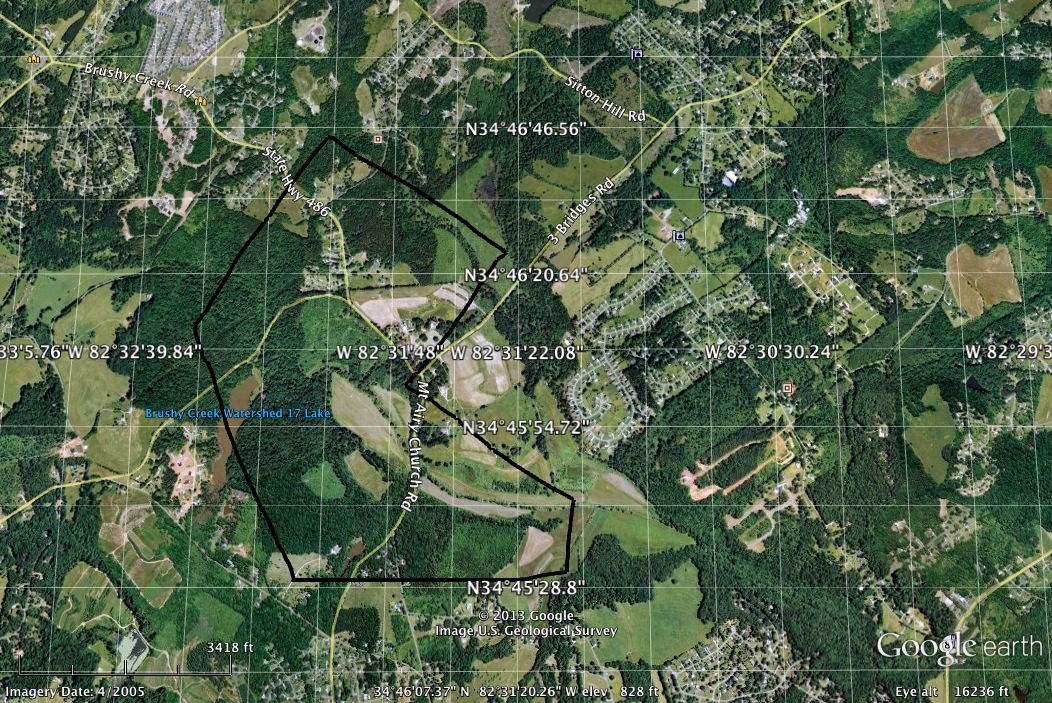
If my brother is correct, then the land of Andrew Hughes was likely located close to the current intersection of Mt. Airy Church Road and 3 Bridges Road in Anderson County.
Do you have good, accurate information that either supports or contradicts my brother’s educated guess about the location of the land? If so, I’d love to hear from you! E-mail me at tahughesnc@gmail.com.
South Carolina pension application of Andrew Hughes, 1826
In my last post, I mentioned both the federal and South Carolina pension applications filed by my 4th great grandfather Andrew Hughes (1755-1843) for his service as a militia soldier in the American Revolutionary War.
Partial transcripts of his federal pension application are available online in at least two different locations that I know of, and there may be others. However, I have never seen a transcript of his South Carolina pension application online anywhere. So, below I am posting my transcription of a photocopy of the document. (I purchased my copy of the document from the S.C. Department of Archives and History.)
To the President and other members
of the Senate and to the Speaker
and other members of the House of
Representatives of the State of
South Carolina.The Petition of Andrew Hughes
Humbly Showeth
That your petitioner
was a volunteer and turned out to defend
his Country against the British Tories
and Indians during the Revolutionary
War. He went a tour of duty against
the Cherokee Indians. The next tour
of duty he went a volunteer in Capt.
Waddy Tate troops of light horse to
Cross Creek where the Scotch were
defeated. The next he was at the
Battle of Camden under the same
Capt. Tate. The next tour of duty he
did was a tour of 9 months. He was
at Charleston, from there to Purysburg
Capn. Jameson. He went from there
up to Augusta and pursued the British
to Briar Creek where he was in
the Battle there. He did four tour,
One of six months, one of nine months
and two of three months each.
He was out from the time he was three
and twenty years of age until the
close of the war. Was in the
Minute Service during the whole
time. Always was ready & went
when called on. Was almost constantly
out on duty. He found himself most of
the time. Found his own horse and
equipage. He says he never received
any pay or anything for his services.
He says he is now seventy one years of
age last April. He has a wife aged
about sixty one years. He says he is poor
and now needs the assistance of his country
for support.He therefore prays your Honorable
Body to grant him a pension or such
other relief as shall to your
Honorable body seem need.
And he will ever pray.
Andrew Hughes (signature)
Pendleton
11th Nov. 1826The State of South Carolina Before me personally
Pendleton District came Andrew Hughsa very respectable citizen of
the District and made oath that
he has resided in the District
constantly for the last thirty-
nine years. That all the
facts stated in the annexed
petition are substantially true.Sworn to 11th Nov. 1826 Andrew Hughes (signature)
Before (?) Grisham
Not. Pub.
Ex Off
G.W. 2State of South Carolina Personally came John
Pendleton District Wilson before me thesubscribing justice, and being sworn in due form of
law, and on his oath saith, that he knew Andrew
Hughs to serve a tour of duty in the Revolutionary War
of six month, under General Rutherford, and that he
himself served with him; and at another time, he
served another tour of duty of nine months with the
said Hughs, under General Aash, and was with
him in the battle at the mouth of Brier Creek.
And that he knew the said Andrew Hughs to
serve in two other campains in the same war.Sworn and subscribed to
before me this 11th day of (Belden?) 1826
John Wilson (signature)A. Douthit Qu.
South Carolina We the undersigned have
Pendleton District for a number of yearsbeen acquainted with Andrew Hughes of this
Dist. and know him to be an honest
endusterous good citizen, now far advanced
in life and not in circumstances to procure
a livelihood without hard labour and
as we believe he rendered important services
in the American Revolution we think
he aught of right to be placed on the pen-
sion list. Sept. 20th 1826(Signed) Ja. Osborn
William Wilson
James Douthit
John Wilson
Andrew HamiltonThe committee on pensions to whom was reported
the petition of Andrew Hughes praying for
a pension, respectfully report
that they have considered the same, and
recommend to this house that the prayer
of the petitioner be granted and that the said
Andrew Hughes be allowed a pension.December 1826
John McComb
Chairman
My earliest Hughes ancestor, Andrew Hughes (1755-1843)
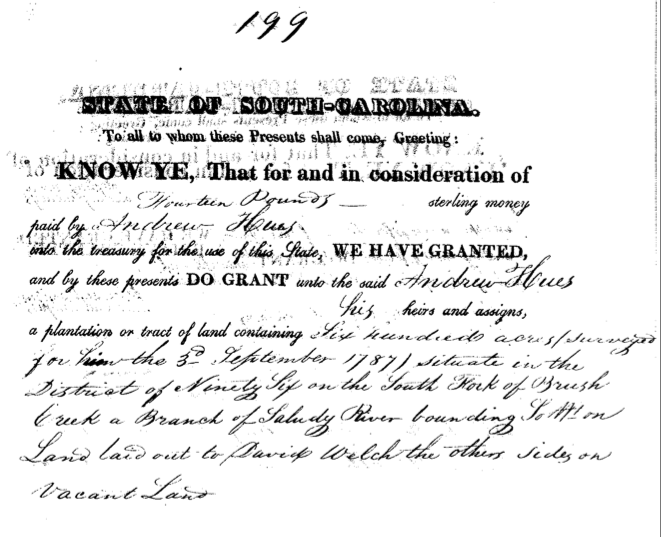
In 1787, 600 acres of land in SC were surveyed for my ancestor, Andrew Hughes.
The earliest Hughes ancestor that I can claim with a reasonable level of confidence is a fellow named Andrew Hughes, who was born near Lancaster, Pennsylvania, on April 4, 1755, and died on or about Sept. 1, 1843, in Pickens County, South Carolina.
Much of what I know about Andrew Hughes, including the locations and dates of his birth and death, is recorded in documents related to two separate pension applications he filed for his service as a militia soldier in the American Revolutionary War. He applied for a pension from the state of South Carolina in 1826 and received payments from the state until 1834, when he applied for and was awarded a federal pension.
According to his federal pension application, Andrew was living in Orange County, North Carolina, when he joined a North Carolina militia unit that formed in Caswell County soon after the Declaration of Independence was signed in July 1776. Some of the campaigns and battles that he took part in were the Rutherford Expedition, Cross Creek (I believe this refers to the battle at Moore’s Creek Bridge), Camden, and Brier Creek.
By 1787, Andrew had settled in the Ninety-Six District (later called the Pendleton District) of South Carolina and he then lived in that area for most of the rest of his life. A land grant record shows that 600 acres of land along “the south fork of Brush Creek” (now known as Brushy Creek) were surveyed for him in September 1787. I believe that this land was probably located somewhere between the present-day town of Easley, S.C. and the Saluda River.
Andrew and his first wife, Obedience Sumner, had several children together; I’m not sure of the exact number. (I do know that I am descended from one of his sons, Elisha, who was born in the Pendleton District about 1800.) Obedience died in 1829. Then in 1835, when Andrew was 75 years old, he married Nancy Mauldin, who was 63. It was a second marriage for her as well.
Andrew and Nancy moved from the Pendleton District to Gwinnett County, Georgia, in 1835, apparently so they could live closer to her children. But the move to Georgia created a problem for Andrew: In 1836 he had to travel back to South Carolina to collect his annual pension payment because there was no other way for him to get it. But while there, he was injured in a fall from a horse. After that, he never returned to his second wife in Georgia. He died in South Carolina seven years later, in the house of one of his sons, Charles Hughes.
Twelve years after Andrew’s death, Nancy filed an application seeking both pension benefits and bounty land as Andrew’s widow. Her application was contested and was the subject of much legal wrangling for more than a year before she was awarded a small pension of $40 a year.
A letter written on her behalf in February 1856 by her attorney, Thomas S. May, provides one possible explanation for why Andrew never returned to Nancy in Georgia. I advise taking this with a grain of salt:
Andrew Hughes returned to South Carolina in the forepart of the next Summer Sometime in June; his Hughes sons all living there in S Carolina Kept the Old man there he being very feeble and old & injured by a fall was not able to return to his family without help which his sons would not afford him, being a drunken set, & perhaps kept him there in order to git his pension money; he being very anxious all the time to return (???) Nancy Hughes then with her children & being very old & infirm could not go back to him in consequence of Bad Health and for want of means.
Note: The above is from my own transcription of the letter. (???) means I could not decipher what was written in that space.
There is still a lot that I don’t know about Andrew Hughes. For example, I don’t know who his parents were, and I have never seen a portrait, drawing or any other likeness of him, so I have no idea what he looked like.
But this much I do know. Hundreds and perhaps thousands of descendants of Andrew Hughes, myself included, are alive today. I personally know of Hughes families in upstate South Carolina, northeast Georgia, the area between Tuscaloosa, Ala. and Columbus, Miss., and in Jacksonville, Fla. that can trace their lineage to him. There are probably many other Hughes families descended from Andrew that I am not aware of.
Perhaps one day we will be able to trace the line back to Andrew’s parents and even farther. I certainly hope so!
James Thompson Hughes: A life marked by the Civil War
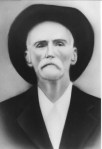
James Thompson “Thomps” Hughes, 1831-1919
My great-great grandfather James Thompson “Thomps” Hughes was born on May 18, 1831, in Habersham County in northeast Georgia.
His parents, Elisha Hughes and Margaret “Peggy” Willson, had been born and raised in the old Pendleton District in the westernmost part of South Carolina. Elisha and Peggy settled in Habersham County in 1827 and their family lived there until 1839.
By 1839, Elisha had disappeared. No one seems to know for sure what happened to him. Some sources say he may have traveled west and then lost contact with his family in Georgia, while others say he may have died while participating in the forced removal of Native American Indians from Georgia that began in the 1830s. Whatever the explanation for Elisha’s disappearance, in 1839 Peggy moved back into the home of her her father, Charles Willson, in Anderson, S.C. (This Willson line later changed the spelling of their surname to “Wilson.”) She took Thomps, who was then 8 years old, and her other minor children with her. She was pregnant at the time of the move and gave birth to William McMurray Hughes in Anderson soon thereafter.
Peggy died sometime before June 1848, when guardianship of Thomps, his sisters, Hulda, Adline and Clarinda, and William was awarded to Peggy’s brother, William McMurray Willson, in Anderson, S.C. But by the time of the 1850 U.S. Census, Thomps and his siblings had moved to Pickens County, Ala., where they lived in the home of their older sister, Harriet Hughes Hamby, and her husband, John W. Hamby.
Thomps married Emmoline “Epsey” Clanton in 1855, when he was 24 years old, and they had three children together before Thomps joined the Alabama 41st Infantry in 1862. He was placed in Company B along with many of his neighbors from communities along the border between Fayette and Pickens counties. Company B also included Thomps’ younger brother, William, and his brothers-in-law James Harvey Wilson (husband of Adline Hughes) and John Wilson (husband of Hulda Hughes).
His service in the Civil War turned out to be a traumatic experience for Thomps, as it was for many other soldiers on both sides, and one that had a huge impact on the rest of his life.
According to a book about the 41st Alabama Infantry by William R. Morales, Thomps’ brother, William, was reported missing in action on Jan. 2, 1863, during the Battle of Stones River near Murfreesboro, Tenn. Union troops placed William on a steamer headed to Camp Douglas, a prisoner of war camp on Lake Michigan outside Chicago. William never made it there. He was taken to City Hospital in St. Louis on Jan. 24 for treatment of typhoid pneumonia, and died there the next day. William was just 22 years old. He is buried at Jefferson Barracks National Cemetery in St. Louis. There is also a memorial for William at Ashcraft Corner Memorial Cemetery in Fayette County, Ala., next to the grave of Thomps.
The Morales book reports that Thomps was absent from his unit and sick on furlough during January-February 1863. In May-June 1863, he was hospitalized at Lauderdale Springs, Miss. Then in November-December 1863 he began a march with the 41st Infantry from Loudon, Tenn. to Knoxville. Union troops found him “incapacitated” near Loudon and then he was hospitalized in Knoxville for 8 days, Dec. 11-19, 1863, with a diagnosis of chronic diarrhea. He never fought again after that.
According to family legend, Thomps’ wife contracted measles while he was fighting in Tennessee. He obtained leave to go home but did not arrive until the day of her funeral, after she had been buried. Thomps began trying to dig up the casket with his hands. After a while other men joined in and helped him complete the task. The casket was opened, and Epsey was found lying on one side. Because of this, Thomps believed that she had been buried alive. (I have no records that confirm this story, but if it happened, January-February 1863, when Thomps was reported to be on furlough, seems to be the most likely timeframe for it.)
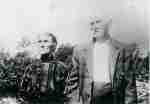
Thomps with his second wife, Jane Mitchell Hughes.
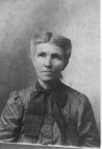
Jane Mitchell Hughes
After the war, Thomps married Jane Mitchell. Their first child, James Harvey Hughes (my great-grandfather) was born in 1867. Their fourth child, Menze Emmanuel Hughes, was born on Nov. 6, 1872. Ten days later, Thomps was committed to Alabama State Hospital for the Insane (better known as Bryce Hospital) in Tuscaloosa, where he remained until his release one year later. At the time of his commitment Thomps was said to believe that his new baby son was the savior of the world, and for that reason he wanted the baby to be named Emmanuel. He reportedly wanted to cut the child’s head off and draw a circle of blood around the world, to redeem the world, according to a family story shared with me by my cousin, Carol Hughes Olive.
After his release from Bryce Hospital, Thomps resumed a normal life, fathered 5 more children with Jane, and lived for another 46 years.
In 1899, when he was 68 years old, Thomps applied for and was awarded a pension from the state of Alabama for his service as a private in the 41st Alabama Infantry. Several men from his community filed affidavits in support of his application, including a J.H. Wilson (likely James Harvey Wilson, Thomps’ brother-in-law, who also served in the 41st Alabama Infantry) and a W. Holiman (likely Warren Holliman, another member of the 41st Alabama).
However, in May 1914, when Thomps was 83 years old, the State of Alabama Pension Bureau sent him a letter stating, “The records show that J.T. Hughes voluntarily took the oath of allegiance, Dec. 16th, 1863, at Knoxville, Tenn, which list shows that this prisoner was sent to Ky there to be released.” In other words, they were accusing him of desertion. He was stricken from the state’s pension rolls as a result.
Thomps responded with a hand-written letter to the Pension Bureau dated May 20, 1914, in which he said his health had been “totally ruined” by typhoid fever in 1862. His brigade left him in a private house near Charleston, Tenn., Thomps wrote, and he was later captured outside Knoxville. He admitted to taking an oath, but said he was “too feeble to understand its wording.” He said he was never sent to Kentucky, as the charges against him alleged, but instead was released in Knoxville.
That letter failed to reverse the bureau’s decision. However, he filed an appeal in July 1915 that led to his reinstatement on the pension rolls, with back pay of $65.60 for the months he had missed. (I am told that the appeal document may have been written by my grandfather, Arley Hughes Sr., a grandson of Thomps who began law school about a year later.)
The appeal document says, in pertinent part:
“Just prior to my capture I had had typhoid fever, near Chattanooga, Tenn. I was sick at the time of my capture, and was in bad physical health for several years after the close of the war, and before I finally recovered I was sent to the Hospital at Tuscaloosa, Alabama, for the Insane, where I remained for about a year.”
“If I took an oath of allegiance, I did not know that I was taking it, as I was very sick physically and to some extent deranged mentally and was not responsible or accountable for what I did. I was not able to fight and did not fight any after I had the spell of typhoid fever above referred to. I was at all times loyal to the Confederacy.”

This photo shows Thomps in his later years.
A document in his pension file stamped with the date of Aug. 22, 1915, confirms the restoration of Thomps’ pension.
He lived for nearly another 4 years, passing away on June 29, 1919. For his last two years he was without the company of his second wife, Jane, who died on Dec. 26, 1917.
Thomps and Jane are buried next to each other at Ashcraft Corner Memorial Cemetery in Fayette County, Ala.
Discovering my rural Alabama heritage
During Thanksgiving week, I traveled from my home in Durham, N.C., to Birmingham, Ala., to spend Thanksgiving with my parents, my girlfriend, Kelley Grogan, and the family of my brother, Brian.

Left to right: Dylan Hughes, Gloria Hughes, Arley Hughes Jr., Tom Hughes, Mary Bess Paluzzi (Associate Dean for Special Collections at the UA Libraries), and Brian Hughes.
Our agenda for Tuesday, Nov. 20 included a trip to the Hoole Library at the University of Alabama in Tuscaloosa, where we donated a collection of 64 letters that my grandfather, Arley Hughes Sr. (1891-1969), wrote to his parents, brothers and sisters in Kennedy, Ala., while he served in the U.S. Army in France during World War I. The library plans to make the letters available on their website later.
After we concluded our business at the Hoole Library, we visited Arley Sr.’s grave, which is in Evergreen Cemetery, across the street from Bryant-Denny Stadium. He graduated from the UA School of Law in 1917, and then got married, before he was drafted into Army service. After returning home from WWI in 1919, he lived the rest of his life in Tuscaloosa.

My grandfather’s headstone.
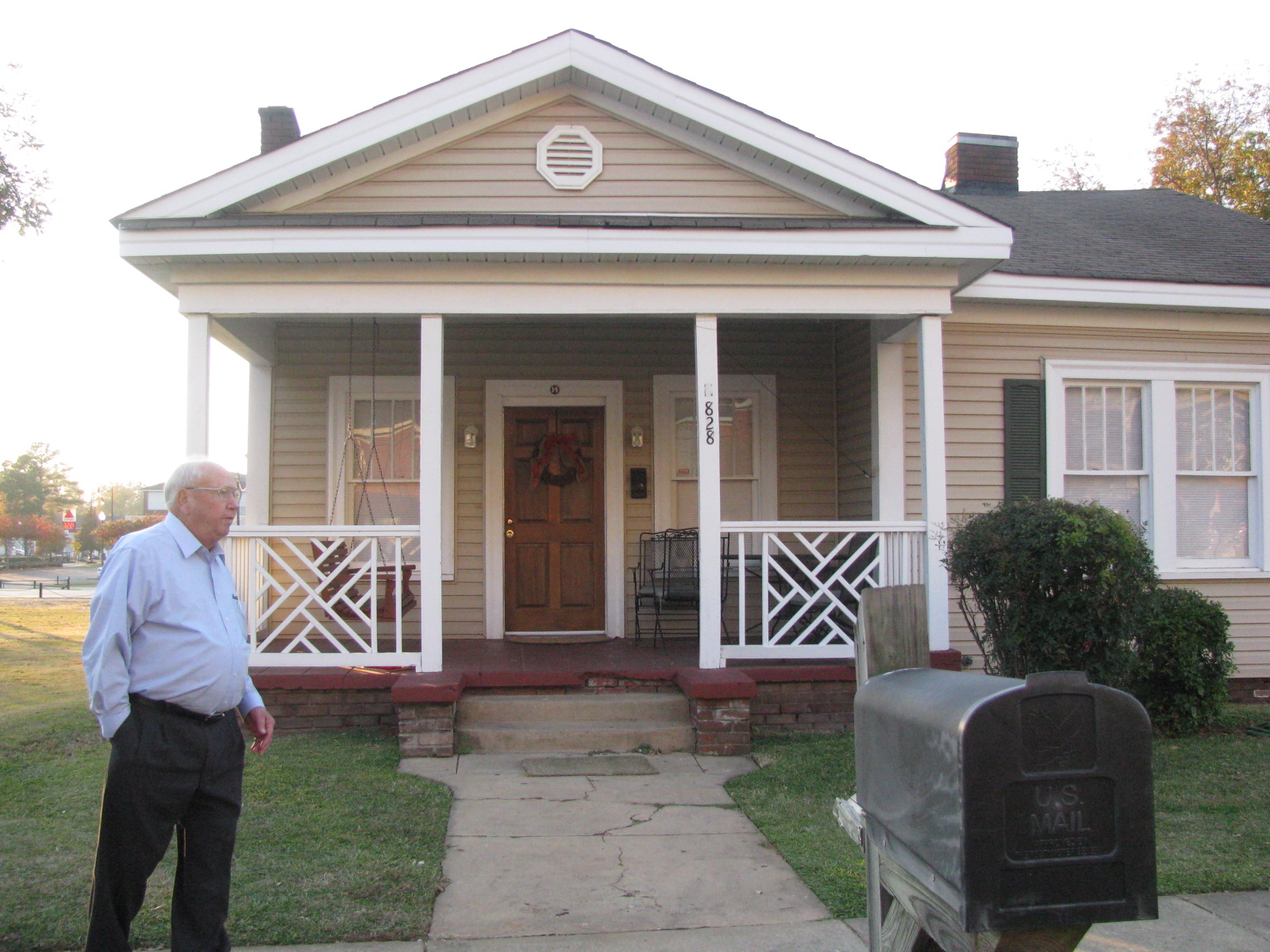
My father lived the first several years of his life in this house at 828 11th Ave.
While in Tusaloosa, we also visited two home sites where my father, Arley “Bill” Hughes Jr., had lived while he was growing up, and a third home site where my mother, Gloria Breland Hughes, had lived. Only one of these homes was still standing. The other two survived a massive tornado that struck Tuscaloosa in April 2011 but have been demolished since then.
On Wednesday, Nov. 21, we went on a self-guided tour of several cemeteries where ancestors of ours are buried. First we visited four cemeteries in the rural area where my grandfather grew up, in the countryside outside Kennedy, a small town of a few hundred residents. Then we visited two cemeteries in Reform, Ala., a larger rural town where my grandfather’s wife, Virginia Ellen “Virgie” Doughty (1896-1978), grew up.

Shown here are me (at left), my father, and my brother, Brian, standing behind the headstone of my 2nd great grandfather, Thomps Hughes.
Our first stop was at Ashcraft Corner Memorial Cemetery, next to Ashcraft Corner Baptist Church. For me the highlight of this cemetery was seeing the grave of our first direct line Hughes ancestor to settle in Alabama, James Thompson “Thomps” Hughes (1831-1919). Thomps was the grandson of our earliest known Hughes ancestor, Andrew Hughes (1755-1843), who was born near Lancaster, Penn. but lived most of his adult life in the old Pendleton District in South Carolina.
Next we visited the Wesley Chapel Cemetery, which is on a dirt road (Wesley Chapel Road) and deep in the woods, about 2.5 miles from Ashcraft Corner Memorial. Here we found several graves of ancestors of ours named Wilson, a family that our Hughes line has been associated with since the 1700s. One example of this association: Thomps Hughes’ mother was Margaret “Peggy” Wilson (1801-1848), who married Thomps’ father, Elisha Hughes, in South Carolina in 1819.
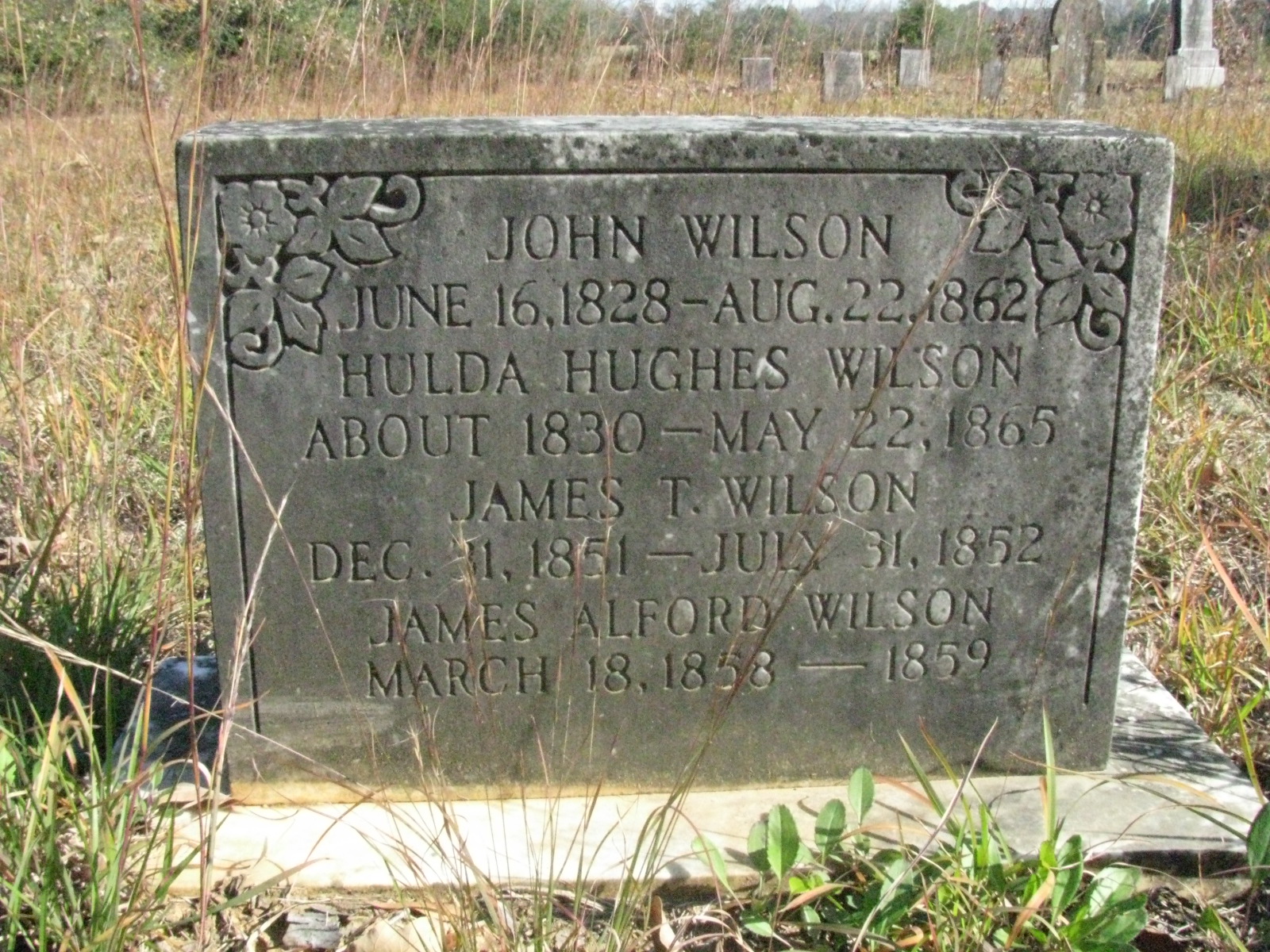
Hulda Hughes Wilson (1833-1865) was a sister of Thomps Hughes. She married John Wilson (1828-1862), who was her first cousin.
We found additional examples of the Hughes-Wilson association at the next cemetery we visited, the Old Wesley Chapel Cemetery (aka, Wilson Cemetery) on Junkins Road, outside Kennedy. There we found the graves of two of Thomps’ sisters, Hulda Hughes Wilson, and Adline Hughes Wilson. Hulda, Adline, Thomps and their younger brother, William M. Hughes, were orphaned after their mother died in 1848 (their father, Elisha Hughes, had disappeared several years before). Custody of the orphans was awarded to their uncle, William M. Wilson, in Anderson, S.C. in June 1848. But by 1850 Thomps, Adline and William were living in Pickens County, Ala., in the home of their older sister, Harriet Hughes (1825-1906), and her first husband, John W. Hamby (1822-1862).
Here are a few more examples of the Hughes-Wilson connection. James A. Wilson (1805-1876) is also buried in the cemetery on Junkins Road. James A. Wilson’s son, John Wilson (1828-1862), was the first cousin and husband of Hulda Hughes Wilson. James A. Wilson also had a daughter named Elizabeth “Eliza” Wilson (1829-1904), who was the grandmother of a fellow named Arley Hughes Sr., who was, you may recall, my grandfather. Another son of James A. Wilson, named James Harvey Wilson (1837-1900), was the first cousin and husband of Adline Hughes Wilson.
Our next stop was the Kennedy Express, a gas station and convenience store with a little restaurant inside. While we had lunch there, the clerk told us about a another Wilson Cemetery nearby, which we set off to see after lunch. This cemetery, like the one at New Wesley Chapel, was on a dirt road deep in the woods.

The headstone of James Harvey Doughty, one of my great grandfathers.
Then we drove to Reform (pronounced “REE-form”). First we visited Arbor Springs Cemetery, and then we visited Graham Memorial Cemetery, which is close to Pickens County High School. Many of my grandmother’s Doughty relatives are buried at Graham Memorial. Arley Hughes Jr. was a school teacher in Pickens County before he went to law school in Tuscaloosa. In fact, he met his wife, Virgie Doughty (my grandmother) when she sent him a letter inviting him to apply for a teaching job. She wrote the letter on behalf of her father, James Harvey Doughty, who was highly active in the civic life of Pickens County.
What did I learn from this trip? It gave me a better understanding than I have ever had before about what life must have been like for my earliest Hughes ancestors in Alabama. They lived on a small farm in an area that even now seems to me very remote, rural and sparsely populated, although it’s only about an hour’s drive from Tuscaloosa. According to my father, the same trip took my grandfather two days by horse and wagon in the early 1900s.
The city I grew up in, Mobile, is in the same state, but the world of my childhood there in the 1960s and 70s was in many ways an entirely different planet from the world my grandfather grew up in. This trip taught me, in a very visceral way, that I am not that far removed from my rural Alabama heritage.
“Oh it was grand!” A World War I soldier’s account of Armistice Day

This head shot of my grandfather was taken in 1917. It was part of a composite for his graduating class from the School of Law at the University of Alabama.
My grandfather, Arley E. Hughes Sr., wrote the letter below on Nov. 11, 1918 to his younger sister, Lela, then 22 years old. At the time he was 27 and stationed in France, where he was serving in Sanitary Squad No. 59 of the U.S. Army’s 81st Infantry (“Wildcat”) Division.
I am posting my grandfather’s letter here, on the 94th anniversary of Armistice Day, because it gives us a firsthand account of an extraordinary day in history as experienced by an ordinary soldier, who wrote the letter to tell the story to his family back home in the small, rural community of Kennedy, Alabama.
In addition to Lela, my grandfather’s letter makes reference to his brother, Eli; to another of his sisters, Ethma, and to his wife, Virgie (my grandmother).
Dear Sister; — The Armistice with Germany is signed and these French and our boys too are in a frenzy of excitement. I’ve never seen people so overjoyed. And I myself am unspeakably happy.
This P.M. flying machines of 3 or 4 countries and of several types flew over us and did all kinds of fancy stunts. Oh it was grand! They would dip right down to the ground and mount to the skies again next minute. They showed how recklessly happy they were.
Lela, words won’t convey an idea of what a flash of color and flags you can see on the streets tonight. See we are in a good big city. The railroad stations are even gay with all the Allied flags, St. cars, autos and every-body.
The next thing is: When will good old Uncle Sam start us home? I won’t complain at all makes no difference if I have to stay till spring. But I do hope I come home earlier.
Lela, Uncle Sam has provided wonderfully for us. We have fared far better than some civilians back home. And honestly I have more and better clothes than ever before in my life. (Tho I bought for $5.00 a tan leather coat the other day. I could not buy the same in civil life for 3 times the money.)
Lela, I weigh 67 kilos or 147-lbs. So you see I am well fed. Eli and I both are over our “flu”
Say, I got a lot of German souvenirs today from Germans. Got 56 coins, 8 pieces of paper money, 1 canteen, 1 match case, 1 match box, 7 identification tags, several buttons, 1 medal, and a few ornaments.
The match box has the iron cross on it.Eli got four or 5 purses and pocket books, a watch, watch case, belt and some money.
Now you’ll be surprised to know that we were trading for another and consequently we got half our purchase without a pennie’s monetary cost.
These Germans would crowd around us like kids. They were crazy for a cigarette. They were so happy because of the cessation of war! One who spoke good English told me in convincing terms how glad they were. He gave me his photo. I’d also got a few others.
Lela, let Ethma and our kin all read this letter. Also send it home if you are writing to homefolks in a day or so.
Listen, I’d give anything almost to see my Virgie to-night. Oh, how happy she is, I know! Homefolks all I guess!
Lela, I make extra in my trading. Have more money than I used to. But of course I don’t make over $2.00 a day. May make $4.00 or $5.00 out of today’s trading.
Your big “bud,”
Arley

 Hughes' Views & News
3 comments